What Is Soil pH and Why Does It Matter for Your Crop Yield?
- Mar 20
- 3 min read
If you have ever had a soil test done, pH is almost certainly the first number on the report. But most farmers, and even many agri-business professionals are not entirely sure what it means or why it matters so much.
This post explains soil pH in plain language, why it is the master variable of soil fertility, and what it means for your farm.
What Is Soil pH?
pH is a measure of how acidic or alkaline your soil is. It is measured on a scale from 0 to 14. A pH of 7 is neutral. Below 7 is acidic. Above 7 is alkaline.
Most food crops grow best between pH 6.0 and 7.5. This range is sometimes called the "sweet spot" of soil chemistry because it is where the maximum number of nutrients are available to plant roots.
Outside this range, even if those nutrients are physically present in your soil, the plant cannot access them. This is the most misunderstood concept in Indian farming. Farmers add fertilizer, but the crop does not respond because the pH is wrong and the nutrients are locked up in unavailable chemical forms.

Why pH Is the Master Variable
Soil pH controls almost everything that happens in your soil: Nutrient availability changes dramatically with pH. Nitrogen, Phosphorus, and Potassium are most available between pH 6 and 7.5. Iron, Manganese, Zinc, Copper, and Boron become more available in slightly acidic soils. Molybdenum becomes more available in alkaline soils.
Soil microbial activity is highest in the pH 6 to 7.5 range. Microbes are responsible for breaking down organic matter and releasing nutrients in plant-available forms. Below pH 5.5 or above pH 8, microbial populations collapse and biological fertility drops sharply.
Fertilizer efficiency is directly tied to pH. A farmer applying urea on a soil with pH 8.5 will lose a significant portion of that nitrogen to ammonia volatilisation before the crop can absorb it. The same farmer applying phosphate fertilizer on a soil below pH 5.5 will see much of it bind to aluminium and iron and become unavailable.
What pH Looks Like Across Indian Soils?
Indian soils show tremendous variation in pH across regions. The soils of Punjab, Haryana, and much of Rajasthan tend to be alkaline, pH 7.5 to 8.5 due to calcium carbonate accumulation and irrigation with alkaline water. This is a common cause of Zinc and Iron deficiency even when farmers have applied these nutrients.
The soils of Northeast India, parts of Odisha, Jharkhand, and the Western Ghats tend to be acidic, pH 4.5 to 6.0 due to high rainfall, leaching of bases, and in some cases historical over-application of ammonium-based fertilizers. Acidic soils often suffer from Aluminium and Manganese toxicity as well as Phosphorus fixation.
The Indo-Gangetic plains have historically moderate pH but are seeing increasing alkalinity in irrigated areas due to poor water quality and sodium accumulation.
How to Correct Soil pH
If your soil is too acidic (below 6.0):
Apply agricultural lime (calcium carbonate) or dolomitic lime (calcium and magnesium carbonate). The quantity depends on your current pH, your target pH, and your soil texture. Sandy soils need less lime than clay soils to achieve the same pH change. Soilo's SoiloRx prescription includes guidance on lime application where pH correction is needed.
If your soil is too alkaline (above 7.5):
Apply gypsum (calcium sulphate) to help leach sodium and reduce alkalinity over time. In more severe cases, elemental sulphur can be used, sulphur oxidises in the soil to form sulphuric acid which gradually lowers pH. This is a slower process but effective over multiple seasons.
Organic matter addition also helps buffer extreme pH in both directions. Well-composted farmyard manure, green manure, and vermicompost all contribute to a more moderate, biologically active soil pH.
How Soilo Measures and Acts on pH
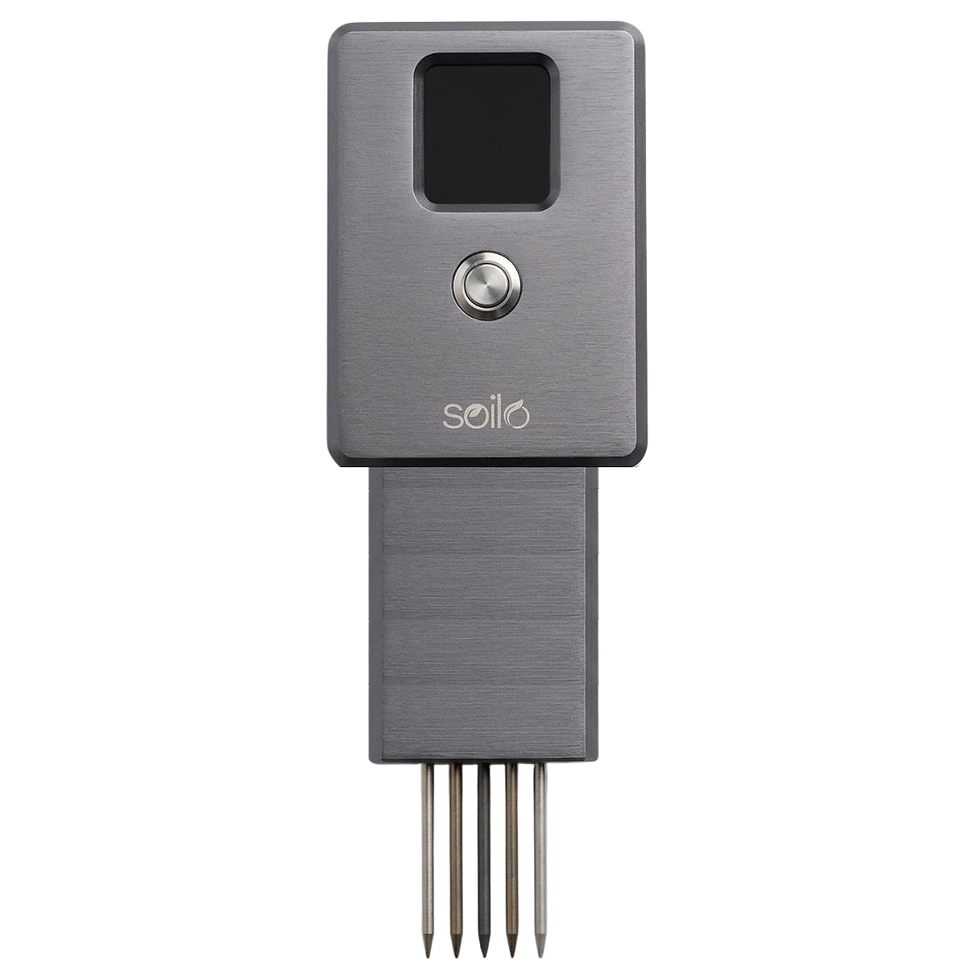
The Soilo device measures soil pH instantly at the farm with no chemicals or lab required. Combined with your crop type and growth stage, the SoiloRx engine tells you not just what your pH is, but whether it needs correction, what to apply, and in what quantity.
Getting your pH right before sowing is one of the highest return investments you can make in soil health. Every other fertilizer you apply works better when pH is in the correct range.
Test your soil with Soilo before the next sowing season. It takes 60 seconds. The results could change your entire input strategy.


Comments