Founder’s journey
From Budaun to Riyadh: representing Soilo on an international stage
· By Soilo · Story date
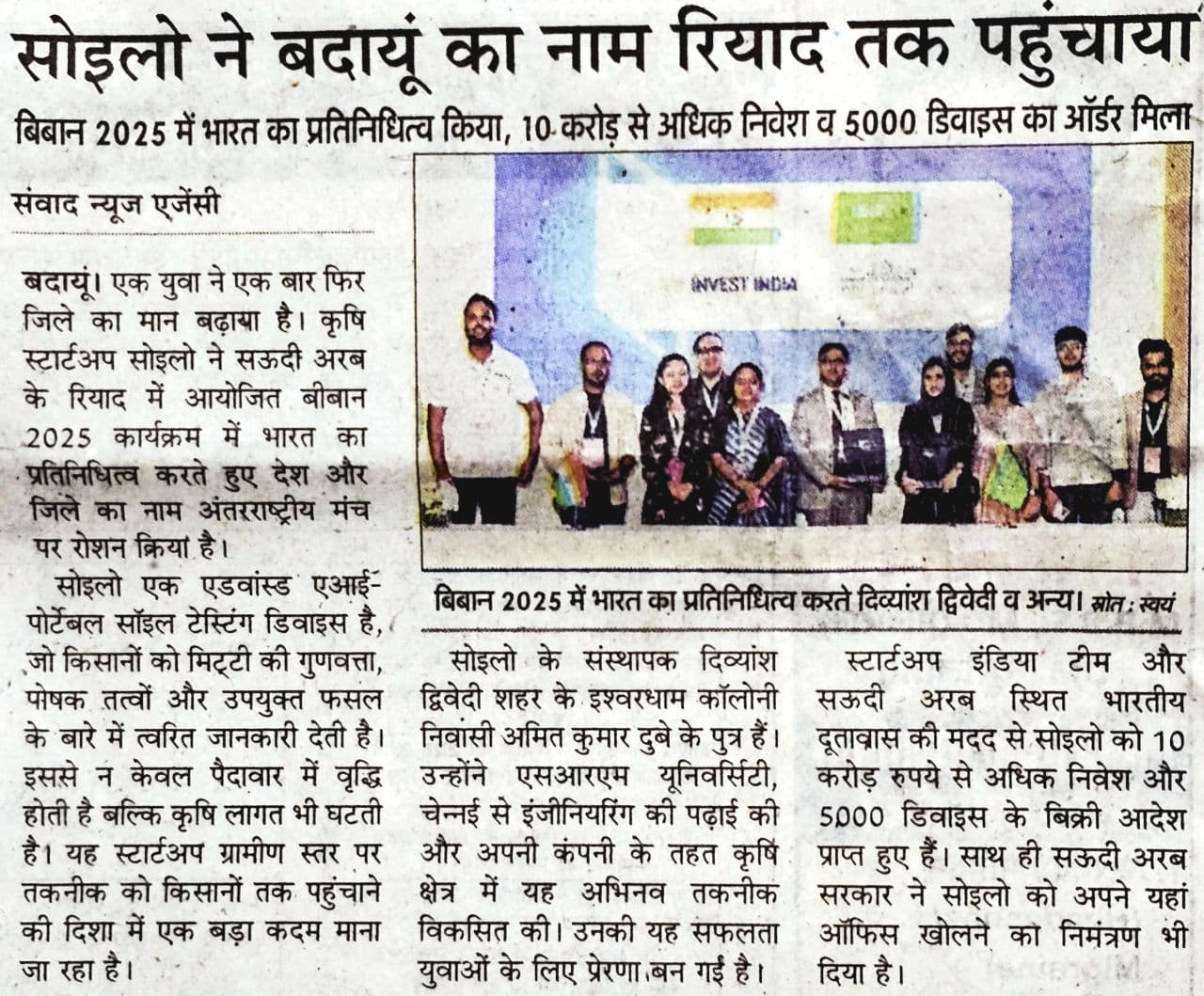
A supplied newspaper clipping records the journey of Soilo’s CEO from Budaun, Uttar Pradesh, to representing the startup in Riyadh.
5 minute read · Published 21 October 2026 · Updated 21 October 2026
Company update
Soilo CEO Divyansh Dwivedi, from Budaun in Uttar Pradesh, travelled to Riyadh to represent the startup. The supplied newspaper clipping records this international chapter of the company’s journey.
A founder’s international chapter, recorded in a clipping
This update is dated 8 November 2025 and focuses on Divyansh Dwivedi’s journey from Budaun, Uttar Pradesh, to representing Soilo in Riyadh. The accompanying Hindi newspaper clipping provides the source image for the story. Its significance is the public record of that geographical and entrepreneurial journey. The account here does not add a new interview or reproduce unverified commercial totals from the clipping as independently established facts.
Representing a startup internationally can connect a local motivation with questions from a different market. The challenge is to explain the problem clearly while remaining attentive to the conditions in which another customer or partner would use the product. That is the broader perspective developed below. It connects the founder’s roots, the practical work of international market development and the responsibility of communicating a product accurately. Those topics add useful background to the supplied account without suggesting that every conversation in Riyadh resulted in an agreement, a sale or an endorsement of Soilo’s current product specification.
Background: turning a prototype into a dependable product
A working prototype and a product that people can use repeatedly are different achievements. A prototype can demonstrate a technical idea under conditions familiar to its builders. A product has to be understandable to someone who was not present during those experiments. Its physical design, operating sequence, software behaviour, documentation and support process have to work together. For a company combining electronics and software, this requires decisions across several disciplines rather than a single breakthrough. An attractive demonstration can start a conversation, but repeatable use depends on the less visible work that follows the demonstration and continues throughout the product’s life.
Hardware and software also affect one another in ordinary operational situations. A field user needs to know whether a device is connected, whether a test is still running, whether a record has been saved and what to do if something interrupts the expected sequence. Engineering therefore includes the design of feedback, error handling and recovery, as well as the underlying measurements. Documentation and training have a similar role. They translate the assumptions of a development team into instructions that another person can follow, including the limits of a feature and the circumstances in which additional help or investigation is appropriate.
Soilo’s founder updates describe rebuilding devices, improving algorithms and addressing problems that became apparent after international deployment. Those reflections help explain why product development is an ongoing responsibility rather than a finished story at the moment of a launch. Feedback can lead to a change in instructions, a clearer interface, a revised process or a technical investigation. The appropriate response depends on the evidence. No single exhibition appearance establishes that every engineering challenge has been solved. The useful lesson is the connection between listening to users, tracing an issue carefully and making improvements that can be communicated, tested and supported over time.
A clipping that connects place, founder and company
The supplied newspaper clipping records Divyansh Dwivedi’s Riyadh journey as a chapter in Soilo’s development. The story date was confirmed as 8 November 2025. That date belongs to the historical account; the archive’s own publication date is recorded separately. The image is available in full so readers can examine the original report rather than rely on a recreated headline. Where the publication’s identity or issue details are not established by the source, the article does not invent them.
The connection with Budaun makes the account more specific than a generic international startup story. It places the founder’s work within Uttar Pradesh while showing an opportunity to introduce the business in Saudi Arabia. The meaning is personal and commercial: someone building a company travelled to represent that company. It is not a claim that the founder held a diplomatic role, represented a government delegation in an official capacity or had authority to make commitments on behalf of public institutions.
For a reader new to Soilo, the founder’s current biography provides a useful continuation. Divyansh Dwivedi is identified in the supplied management profile as Co-founder and CEO, with responsibilities including product strategy and hardware–software integration. Aditi Mishra is identified as Co-founder and Managing Director, with responsibilities spanning business operations and commercial coordination. Those profiles help place a founder-focused clipping within a wider organisation. They should not be used to assign unverified qualifications or titles to people appearing in event photographs.
International attention and practical readiness
An international opportunity can test how clearly a team explains its product to people unfamiliar with its starting context. A person who has never encountered the company may need a concise account of the intended user, the information produced and the conditions required for useful operation. The explanation should not depend on assuming that every audience shares the same agricultural practices or commercial expectations. This is relevant background to international product communication, rather than a report of specific questions asked during the Riyadh visit.
For a soil-assessment tool, careful communication includes the relationship between a field reading and a decision. A result needs to be understood alongside sampling conditions and the purpose of the assessment. Portability does not make all soils identical, and a digital report does not remove the need for appropriate interpretation. The technical documentation should state what the device reports and how the supporting evidence is scoped. A media clipping can introduce the company, but it cannot replace that evaluation for a prospective user.
Commercial readiness has its own questions. An enquiry from another country may involve delivery terms, support, documentation and permissions that differ from a domestic sale. Discussing those requirements does not mean an agreement has already been reached. The Riyadh clipping contains no basis for adding an overseas distributor appointment, investment amount or sales total. Its contribution is the record of a founder taking the company’s story to an international setting.
The wider archive provides related but separate views of that period. BIBAN is described through the Startup India delegation account. The entrepreneurship MoU article records attendance at an institutional signing occasion. The innovation roundtable article records an invitation on 12 November. Reading those stories alongside this clipping gives a more complete chronology while preserving their different evidence and roles. The Budaun-to-Riyadh story remains the founder-focused account: a connection between where the work began, the company being built and a new audience abroad.