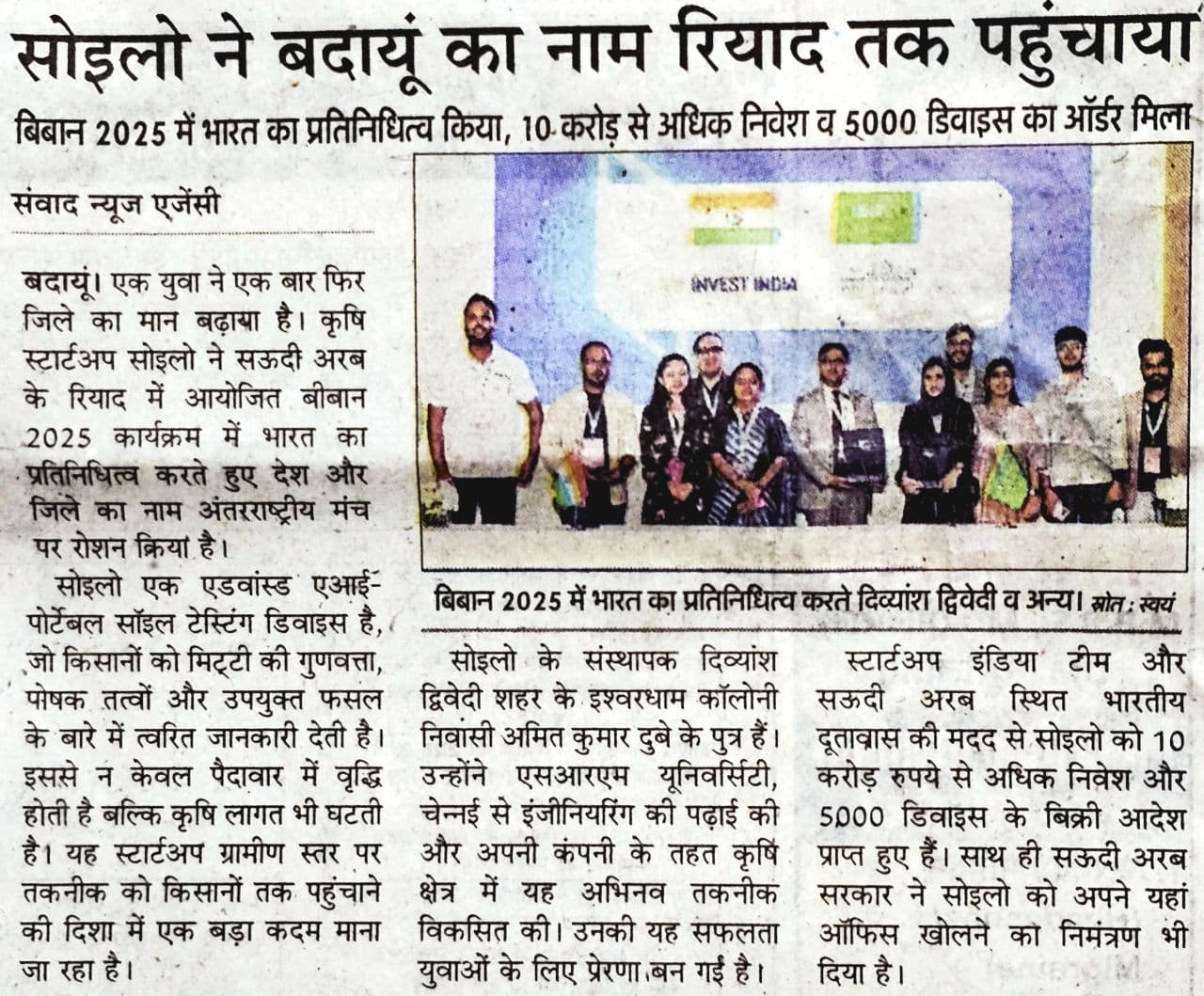
Soilo Represents Indian Agritech Innovation at BIBAN 2025 in Riyadh
· By Soilo · 6 minute read
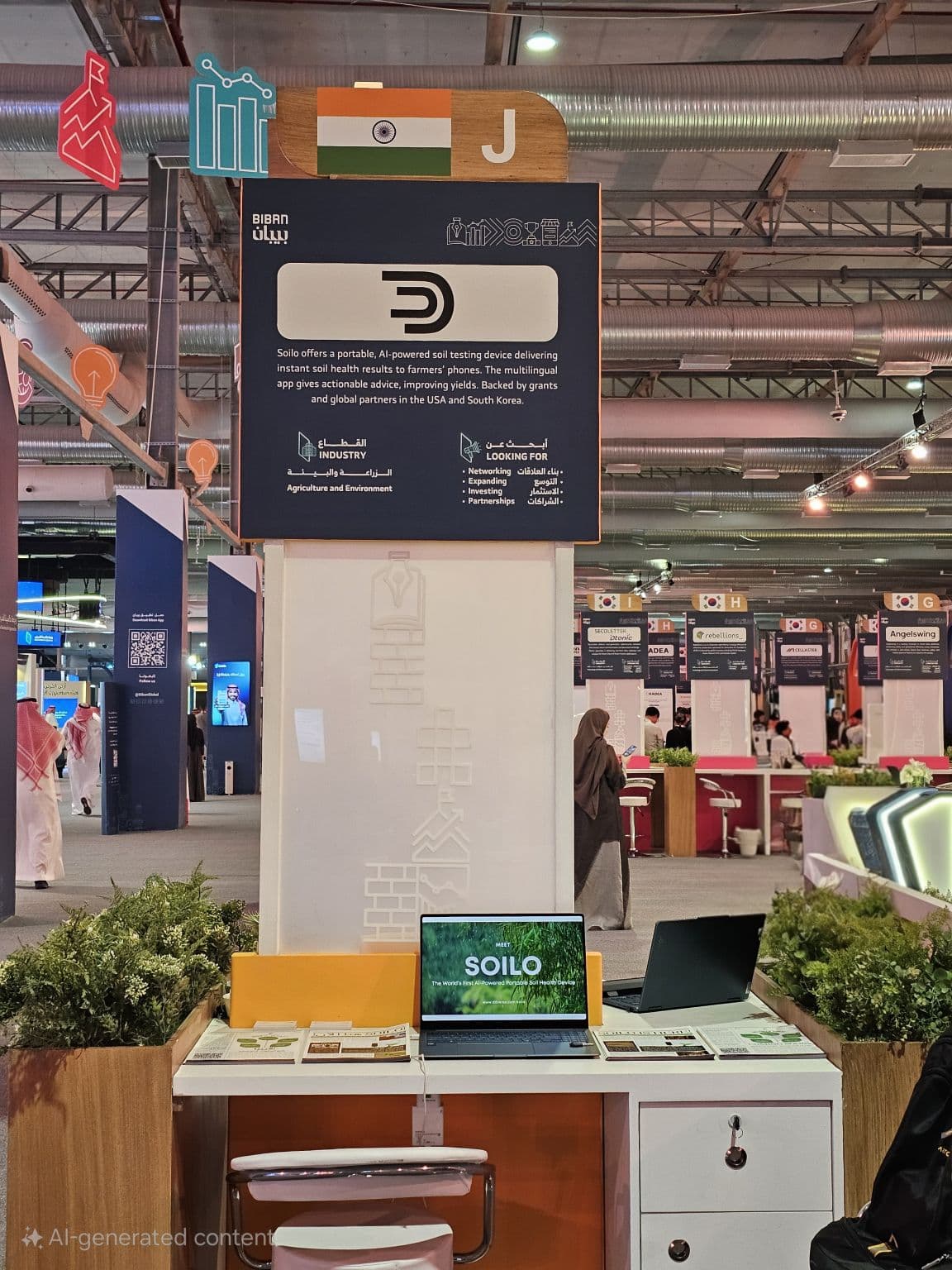
Soilo joined BIBAN 2025 in Riyadh as one of ten startups in the Startup India delegation, bringing our work in portable soil intelligence to an international audience. For a young agricultural technology company built in India, the opportunity to participate was both exciting and instructive. We were able to introduce our approach to field-level soil information, engage with visitors from different backgrounds and learn more about what potential users and partners expect from an Indian hardware and software business operating globally.
BIBAN brings together entrepreneurs, enterprises, investors and ecosystem institutions. That breadth matters because agricultural technology cannot develop in isolation. A device may begin with a technical idea, but its successful use depends on farmers, agronomists, distributors, training teams, manufacturers and others who understand how the technology fits into everyday decisions. International exhibitions make those connections possible in a way that ordinary product announcements cannot.
Presenting a practical approach to soil intelligence
Our focus at BIBAN was the challenge that led us to build Soilo: useful soil information is not always easy to obtain at the point where a decision needs to be made. Farmers and field teams often operate under time, distance and resource constraints. Laboratory analysis remains essential for many applications, particularly where reference-grade results are required. We are developing portable technology and digital workflows to make more information available during field activity, while supporting clearer records and follow-up decisions.
Soilo's product approach combines sensing hardware with software that helps users view and organise results. A field-oriented workflow has to be simple enough to use repeatedly but careful enough to communicate what its outputs mean. That includes being transparent about direct measurements, model-derived values and the need for independent confirmation in particular circumstances. The technology becomes valuable when it helps a person act more intelligently, not merely when it displays more numbers.
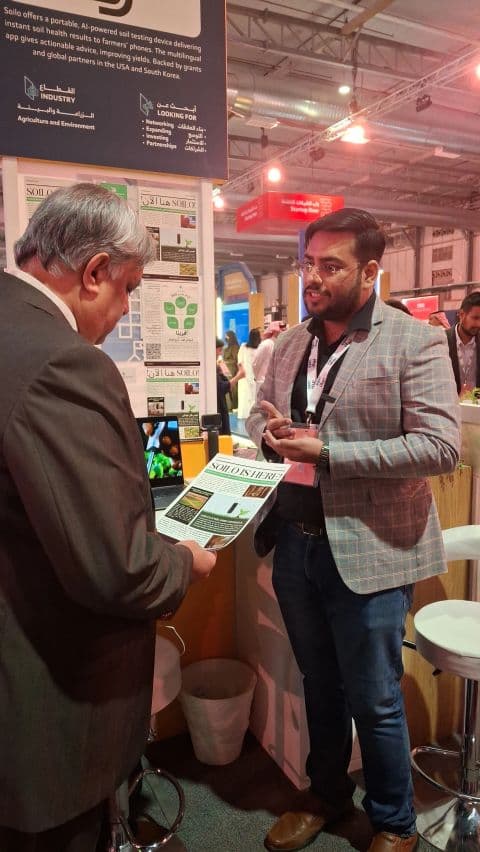
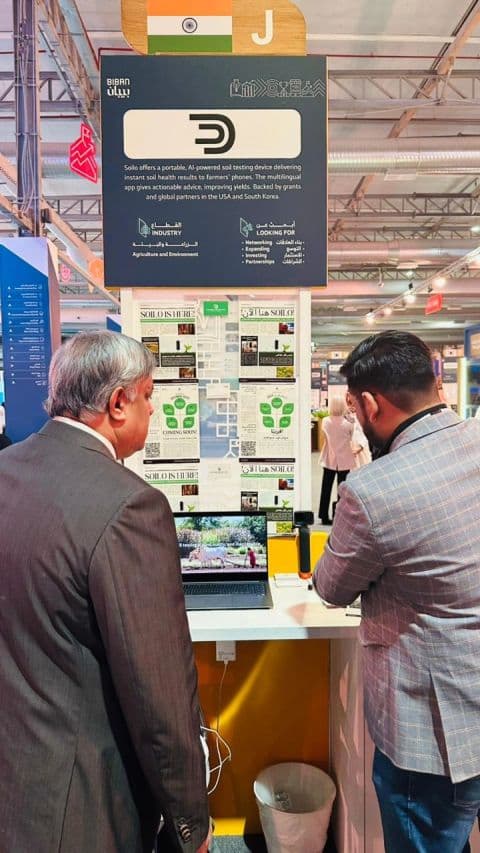
At a major international exhibition, explaining this distinction is an important part of presenting the product. Visitors naturally want to know how readings are produced, whether a device can operate in different environments, what the software offers and how the company supports users after delivery. These are the right questions. They help us understand where the product fits and what still needs to improve.
A proud moment at the Indian Startup Pavilion
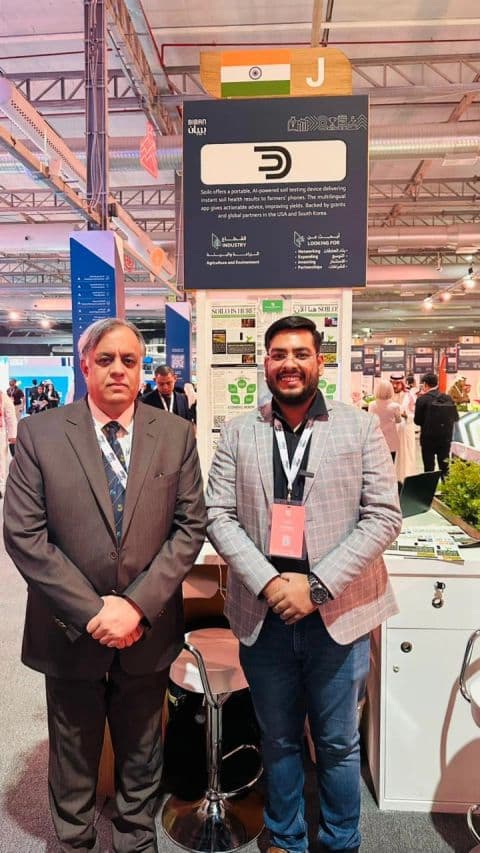
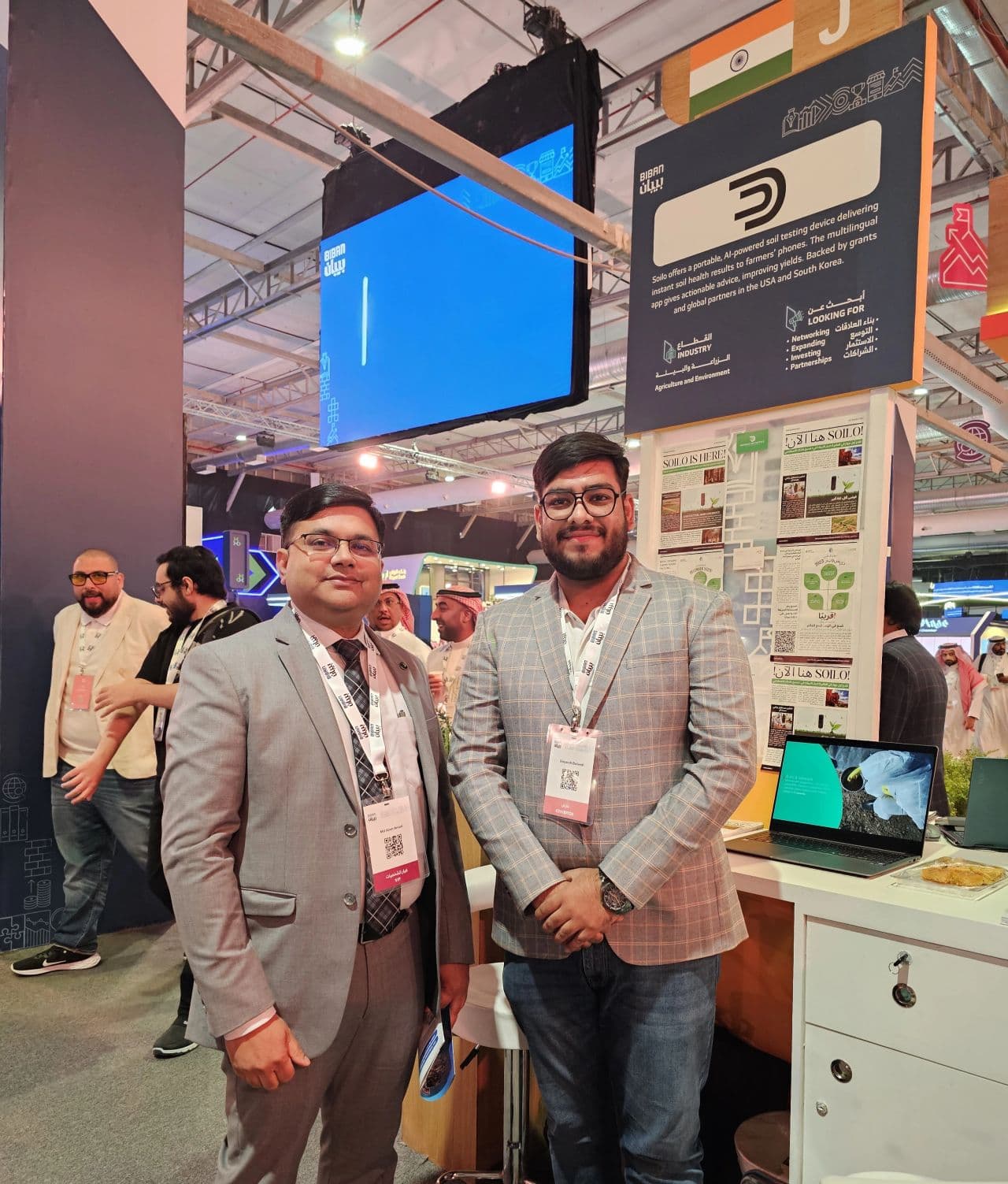
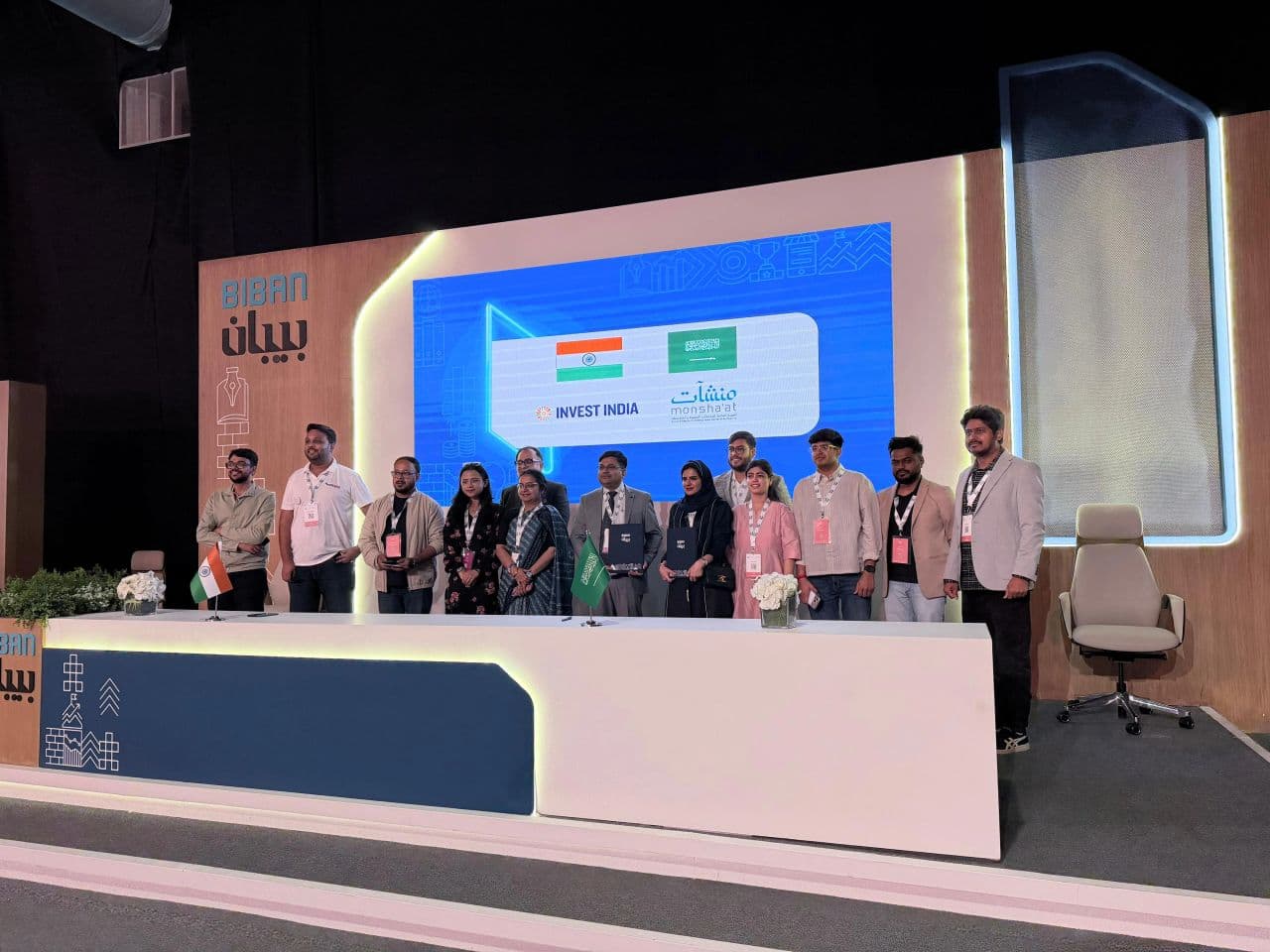
One of the memorable parts of our participation was the inauguration of the Indian Startup Pavilion. We had the honour of meeting H.E. Dr. Suhel Ajaz Khan, Ambassador of India to the Kingdom of Saudi Arabia. His encouraging engagement with the Indian startup community made the occasion particularly meaningful for our team. We also appreciated the opportunity to meet Shri Md. Alam Ansari, Deputy Director, DPIIT (Startup India), during the delegation's activities.
Being part of the delegation was a source of pride, but we see it as a responsibility rather than a badge that can substitute for performance. Our participation gave us a platform to present the company as part of India's growing startup ecosystem. It did not make Soilo a representative of the Government of India, and it did not imply any government guarantee of our products. We value the opportunity because it enabled us to take part in substantive conversations and make our technology more visible.
Those conversations also reflect the broader work of institutions that help early companies reach audiences they could not easily access alone. A startup's ability to exhibit internationally often depends on an ecosystem of organisers, mentors, public initiatives and private supporters. We are grateful for that ecosystem and for the opportunity to contribute our own experience as a hardware-led company.
Learning what another market needs
Agriculture in Saudi Arabia operates under conditions that differ in significant ways from many Indian settings. Questions involving soil management, water use, environmental monitoring and resource efficiency are especially relevant. Yet it would be a mistake to assume that a product demonstrated in one country is automatically suited to every use in another. Soil characteristics, sampling methods, operator training and local requirements all affect how technology should be evaluated.
International exposure helps us ask better questions. What is the operating environment? Who will use the device, and how often? Which results matter most to their workflow? What form of reporting would be useful? When should field observations be compared with laboratory findings? Would a local partner need technical training or additional documentation? These questions guide responsible product development and prevent a promising conversation from becoming an unrealistic expectation.
We are interested in building relationships that begin with this practical understanding. A distributor needs more than an attractive product description. An agronomist needs confidence about interpretation. An enterprise needs clarity about records, access and support. A farmer needs the technology to help solve an actual problem. Each of these perspectives is important as we consider international opportunities.
Building hardware for an international audience
Hardware introduces responsibilities that can be easy to underestimate at a business exhibition. Components need to be available, assemblies need to be consistent and devices need to be checked before dispatch. Instructions have to be understandable. Software needs to fit the customer's operating environment. Support cannot disappear after a shipment leaves India. We consider these requirements part of the product itself.
At Soilo, that means continuous attention to manufacturing quality, firmware behaviour, application usability, field feedback and customer service. We are still learning, and international conversations help us identify areas that deserve more testing or clearer explanations. A customer thousands of kilometres from our office should not have to understand our internal organisation to receive help. They should experience one company taking responsibility for its work.
The event also reinforced the importance of distinguishing technological potential from established capability. We are expanding our thinking from soil testing towards broader ground intelligence and environmental information workflows. Applications related to sustainability and organisational reporting can be valuable, but their requirements vary. Collecting field data is not the same as proving an environmental outcome, and any such claim must have a defensible method and appropriate evidence.
What we took away from Riyadh
BIBAN 2025 gave Soilo a chance to introduce its mission internationally, meet people who care about innovation and learn from the questions they asked. We returned with a deeper appreciation for the work needed to turn attention into genuine customer value. Our next steps after an exhibition are always practical: follow up carefully, understand the intended application, explain the technology accurately and make sure our team can support whatever we commit to deliver.
We are thankful to Startup India and the delegation organisers for the opportunity, to H.E. Dr. Suhel Ajaz Khan and Shri Md. Alam Ansari for their encouragement, and to everyone who engaged with Soilo during the event. We are also thankful to the colleagues in India whose engineering, manufacturing and operational work allowed us to stand at an international pavilion with a product to demonstrate.
We went to BIBAN proud to be building from India. We came back reminded that global ambition must be matched by the day-to-day discipline of building useful, supportable technology. That remains the direction of Soilo, and we look forward to the relationships and learning that began in Riyadh.
Photo gallery