Soilo Selected for the Uttar Pradesh Pavilion at Electronica India 2026
· By Soilo · 6 minute read
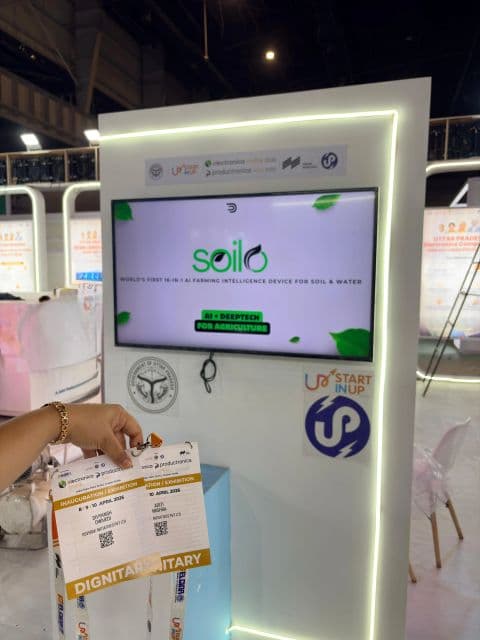
Soilo was selected as one of six startups given the opportunity to participate through the Uttar Pradesh Government pavilion at Electronica India 2026 in Greater Noida. For our team, the announcement was especially meaningful because it recognised the engineering work behind a company that many people first encounter through its agricultural applications. We build technology for people working with soil and environmental information, but making that technology useful begins with electronics, embedded systems, software and manufacturing decisions.
Electronica India provided an appropriate setting for those capabilities to be discussed alongside a broader hardware and technology community. We were grateful to ITSEC NFED and StartInUP for the opportunity and support associated with the selection. The event was scheduled in Greater Noida for 8 to 10 April 2026. This article reflects our participation announcement; it does not make additional claims about completed commercial agreements or exhibition outcomes that were not part of that announcement.
Where agriculture meets electronics
Agritech is often described primarily through farming outcomes, but there is considerable engineering between a field problem and a usable product. A portable device needs suitable sensing interfaces, a stable power system, communication between hardware and software, mechanical protection and a design that can be manufactured consistently. An application has to handle pairing, data capture and reporting. The full experience has to remain understandable to the person operating it in the field.
At Soilo, that combination defines much of our work. We are building portable soil intelligence technology and related digital tools with the aim of making useful environmental information more accessible. The opportunity to join an electronics-focused exhibition was a chance to show that this work belongs in the conversation about product engineering as well as the conversation about agriculture.
We wanted to connect with people who understand what it takes to move from an electronics prototype to a dependable commercial device. Component selection, supply consistency, calibration methods, enclosure design and quality assurance are not background details. They directly influence whether a user trusts a product and whether the business can support it over time.
The responsibility behind a hardware product
A new device may look convincing during a demonstration, but field operation presents harder conditions. Power supplies vary. Operators follow instructions differently. Connectivity can be intermittent. Environmental exposure can affect handling and performance. Results may differ across soils and locations. Building for those circumstances requires testing and a willingness to revise design choices when real use reveals a weakness.
For a hardware-led startup, that learning process has to be reflected in manufacturing. Every unit should pass through defined checks. Firmware must be appropriate to its hardware configuration. Mechanical components must be assembled consistently. Documentation should explain the intended use without promising capabilities the system cannot support. Customer support has to be able to investigate problems and feed useful information back into development.
We see hardware exhibitions as opportunities to discuss these realities with specialists who share similar challenges. A conversation about a circuit, connector or production process can ultimately improve the experience of a farmer who never attends an electronics event. The relationship between engineering discipline and user value is direct, even when it is not immediately visible.
Six startups, one opportunity to represent local innovation
Being selected among six startups for the Uttar Pradesh Government pavilion was a proud moment for Soilo. We value the work being done to create opportunities for companies emerging from the state's startup ecosystem. Exhibiting within a pavilion can help young teams introduce their work to visitors who might otherwise be difficult to reach and place their products alongside a wider range of technology businesses.
We also recognise that a selection opportunity is not the same as a certification of product performance or an endorsement of every technology claim. Its value is the visibility and the chance for meaningful interaction. We want to use such opportunities to explain what we have built, acknowledge the work still ahead and listen to people whose expertise can help us improve.
Our thanks go to ITSEC NFED and StartInUP for their involvement, as well as the colleagues and supporters who have helped Soilo develop as a technology business in Uttar Pradesh. The broader message for us is encouraging: hardware innovation is not limited to a small number of established companies. Young teams can develop specialised products, manufacture in India and participate in conversations that reach a global technical audience.
Building an integrated product, not just a sensor
At Soilo, a soil reading is only one part of the user's experience. The person operating a device needs to understand how to prepare for a test, how to record the result and how that information should be interpreted. The application needs to present relevant data clearly and support a useful record of field activity. These requirements shape our choices in electronics and firmware as well as in software.
The distinction between direct sensing and model-supported outputs is particularly important. A single product may present several parameters, but those parameters do not necessarily share the same measurement method. Good design should make those differences understandable. Where laboratory confirmation or independent validation is required, a portable field device should be positioned as part of a wider workflow rather than as a substitute for every method.
These principles will continue to guide us as Soilo develops a broader portfolio of environmental intelligence tools. We are interested in the links between soil, water, climate and other observable conditions, and in software that helps organisations manage information collected from the field. Each product category introduces its own engineering constraints and requires its own validation. A stronger electronics foundation makes responsible expansion possible.
Connecting with builders and technical partners
The reason we wanted to participate at Electronica India was straightforward: we wanted to meet people who build, manufacture, evaluate and improve technology. Discussions with electronics specialists, hardware founders and relevant suppliers can help a product company challenge assumptions about design, reliability and production. Those relationships matter even when they do not lead immediately to a transaction.
We believe partnerships should begin with a clear technical purpose. A supplier conversation should help resolve a component, production or quality requirement. A prospective customer should understand the intended application and limitations. A technology partner should be able to explain how an integration would work in practice. Events are useful when they help make those conversations more specific.
Our roots remain in agricultural and environmental challenges. But we do not see agriculture and electronics as separate worlds. The quality of field information is shaped by the quality of the instruments and digital workflows used to collect it. Better electronics can contribute to better usability, repeatability and operational reliability when paired with thoughtful methods and appropriate testing.
Looking beyond the pavilion
The Electronica India announcement represented another step in Soilo's journey as a company building physical products and software in India. We are grateful for the opportunity to be visible in a major technology setting and proud of the team whose work made the selection possible.
The most important work remains the work after the announcement: refining device architecture, improving user experience, strengthening quality processes and listening to customers. We aim to build tools that are useful in real operating conditions, not just impressive in a display case. That goal requires steady effort from engineering, manufacturing, software and customer-facing teams.
To everyone interested in electronics, embedded systems, hardware manufacturing and agritech, we look forward to continued conversations. Soilo is building at the intersection of those fields, with a practical ambition to make environmental information more accessible and useful. The Uttar Pradesh pavilion opportunity was a welcome recognition of that journey, and we intend to honour it by continuing the work.