Celebrating Student Innovation at NewGen Demo Day 2025
· By Soilo · 6 minute read
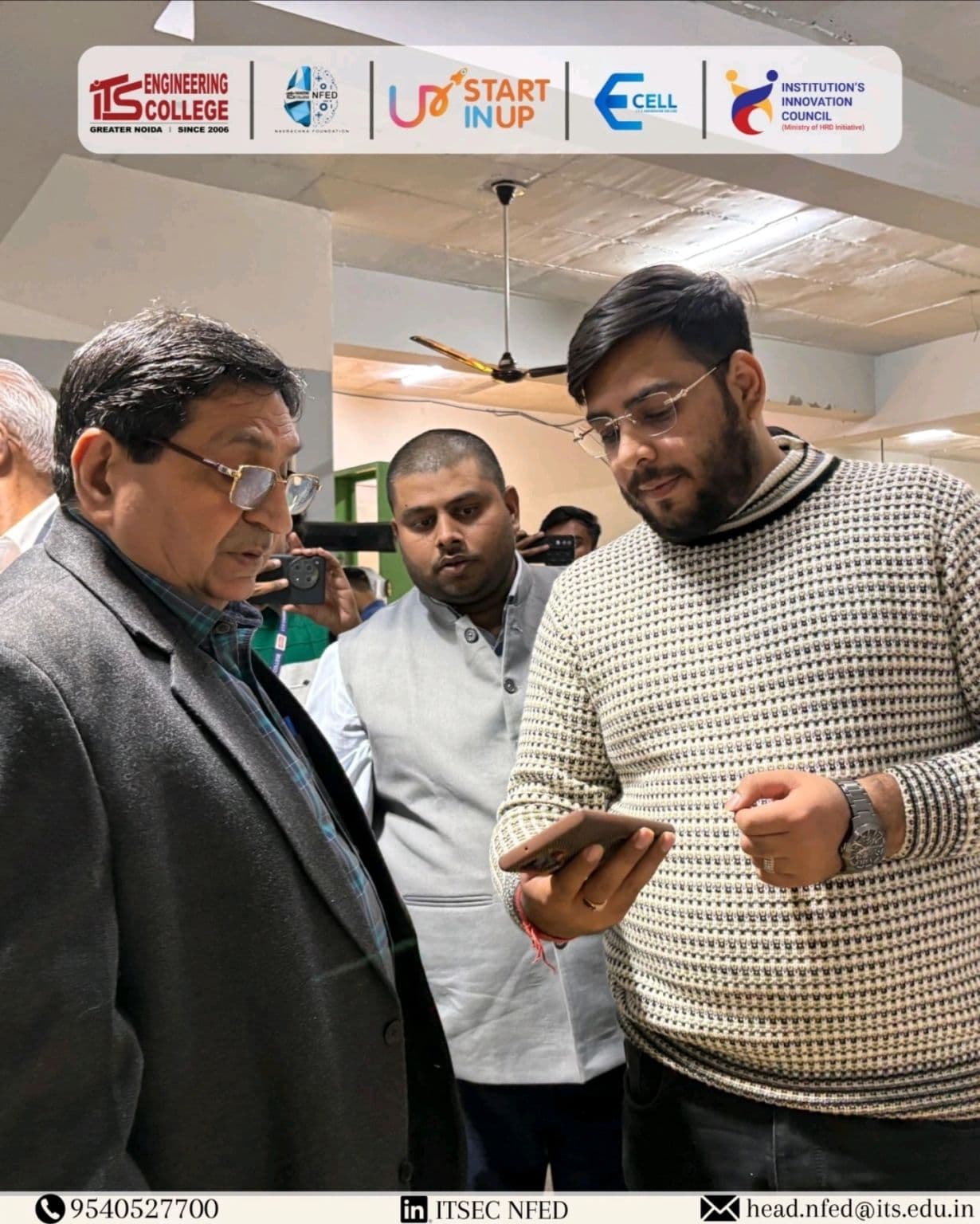
Every technology company begins with someone asking whether a problem can be solved differently. Before there is a product, a customer or a business, there is usually an idea that needs to be tested. That spirit was at the centre of NewGen Demo Day 2025, organised by NewGen IEDC at I.T.S Engineering College, Greater Noida. We are pleased to celebrate an initiative that brings students, faculty members, aspiring founders and experienced innovators together around the difficult and rewarding work of turning ideas into working solutions.
The event created a platform for prototype demonstrations, startup presentations and constructive exchanges across the innovation community. We value such opportunities because Soilo's own journey began with questions that could not be answered through a presentation alone. An idea needs to meet a technical challenge, be tested, improve after feedback and eventually address the needs of someone beyond the development team.
Where a promising idea begins to take shape
A student project can be one of the most productive environments for experimentation. Teams can explore an unfamiliar technical problem, investigate different approaches and learn what happens when a design encounters practical constraints. A demonstration makes that learning visible. It reveals not only what the team has achieved, but also what remains uncertain and where further investigation may be needed.
NewGen Demo Day gave participants the chance to present that work and discuss it with people who could offer technical and entrepreneurial perspectives. The presence of students, faculty, startups and mentors helps connect early experimentation with a broader understanding of how products are developed. We believe this relationship is essential. Technology improves when people with different experience can ask questions of the same problem.
For a student founder, that process is valuable even when the first idea does not become a company. Learning to explain a problem clearly, justify a design choice, document a test and accept feedback builds skills that last beyond one event. A prototype may fail or change direction, but the ability to investigate and improve remains.
Lessons familiar to our team at Soilo
We recognise many of the challenges faced by early innovators because they are part of our own experience. Soilo began with the question of how useful soil information could be made more accessible through portable technology. Developing an answer has required repeated work across sensing hardware, embedded software, mobile applications, manufacturing and field use.
The path from an idea to a dependable device is rarely direct. A proof of concept may establish that a principle is possible without demonstrating that a customer can rely on it. Components may behave differently under new conditions. Software may be clear to the developer but confusing to the first-time user. Field tests may expose assumptions that were not apparent in the laboratory. Progress comes from identifying those gaps and addressing them rather than hiding them.
That is why we encourage student teams to think carefully about the problem behind their demonstration. Who will use the product? What existing method are they comparing it with? What evidence supports their claims? What would happen if the product failed during ordinary use? These questions are not intended to discourage ambition. They help give ambition a practical direction.
The role of faculty, mentors and institutions
The NewGen IEDC event acknowledged distinguished guests and academic contributors, including Prof. S. B. Sareen, Dr. Naveen Vasishtha, Dr. S. P. Mishra and Dr. Mayank Garg. Their participation reflects the importance of knowledgeable guidance in the early stages of innovation. Experienced mentors can help students identify weaknesses, sharpen a problem statement and understand the difference between a successful classroom project and a solution suitable for real users.
Institutions also provide something that individual founders may find difficult to create: a structured environment in which experimentation is encouraged. Access to laboratories, peers, technical faculty and opportunities to demonstrate work can help ideas develop with greater discipline. Events bring those resources together and create reasons for students to complete, explain and defend their thinking.
We appreciate the effort of NewGen IEDC and I.T.S Engineering College in creating such a platform. Stronger student innovation ecosystems benefit not only the teams participating on the day, but also the companies, research groups and communities that may eventually employ or collaborate with those innovators.
What makes a demonstration useful
An impressive demonstration is often the beginning of a conversation, not the end of the development process. Audiences may be interested in the feature that is most visible, while the real technical difficulty lies elsewhere. A connected device, for example, may appear to be about the reading shown on a screen. Its reliability also depends on power management, communication, calibration, mechanical design, software handling and the way the result is interpreted.
Similar distinctions apply to software, sustainability products and data systems. A model can generate an output, but its limitations should be understood. An application can organise information, but it still needs to meet the user's workflow. A sustainability-related project can identify a potential improvement, but a measured impact requires an appropriate method and evidence.
We hope events such as NewGen Demo Day encourage teams to articulate those boundaries confidently. Clear statements of what has been tested are more valuable than broad promises. A founder who can explain the limitations of a prototype is often better prepared to decide what should be built next.
Innovation is also a team skill
Student projects teach collaboration under uncertainty. Teams must divide responsibilities, integrate different pieces of work and make decisions when there is not enough time to test every possibility. These are the same difficulties found in young companies. Hardware, software and business functions rarely progress at identical speeds, and a good product depends on learning how to coordinate them.
At Soilo, we see collaboration as one of the most important capabilities a team can develop. Our work is not only about electronic components or application features. It involves people who understand customer needs, people who build the technology and people who make sure it reaches users in a usable form. The sooner young innovators appreciate how these disciplines interact, the stronger their future projects can become.
We also encourage teams to stay close to the people affected by the problem. A technology concept should be tested against the realities of its intended setting, whether that is a farm, a manufacturing floor, a classroom or a public service. Feedback from prospective users can be as important as feedback from technical mentors.
Building the next generation of problem-solvers
India needs people who are willing to work on difficult, practical challenges and give them the time and care they deserve. Student innovation events help create that community. They make experimentation visible and encourage young people to see themselves as builders rather than passive users of technology.
We congratulate the organisers, participating teams, faculty and guests associated with NewGen Demo Day 2025. We are glad to share this milestone from the innovation community and to acknowledge the effort involved in organising an environment where students can present their ideas seriously.
For our team, the most encouraging part of such events is not the number of prototypes on display. It is the possibility that some of the people presenting today will continue learning, testing and building solutions that improve lives. Soilo itself is a work in progress, and we know how much can be learned from a single useful question.
We look forward to seeing more opportunities that bring engineering education, entrepreneurship and practical problem-solving together. The future of innovation will be shaped by people who can combine curiosity with evidence and imagination with execution. NewGen Demo Day is an encouraging example of that effort.