Soilo at IFTEX Kenya 2026: Bringing Soil Intelligence to Floriculture Conversations
· By Soilo · 6 minute read
Soilo's presentation at IFTEX Kenya 2026 marked another opportunity to introduce agricultural technology developed in India to an international audience. The exhibition is associated with Kenya's flower industry, where decisions about growing conditions, crop health and production consistency are closely connected to the practical management of soil, water and other resources. For our team, joining conversations in this environment was an important part of understanding how portable soil intelligence could be evaluated by agricultural professionals working in specialised production systems.
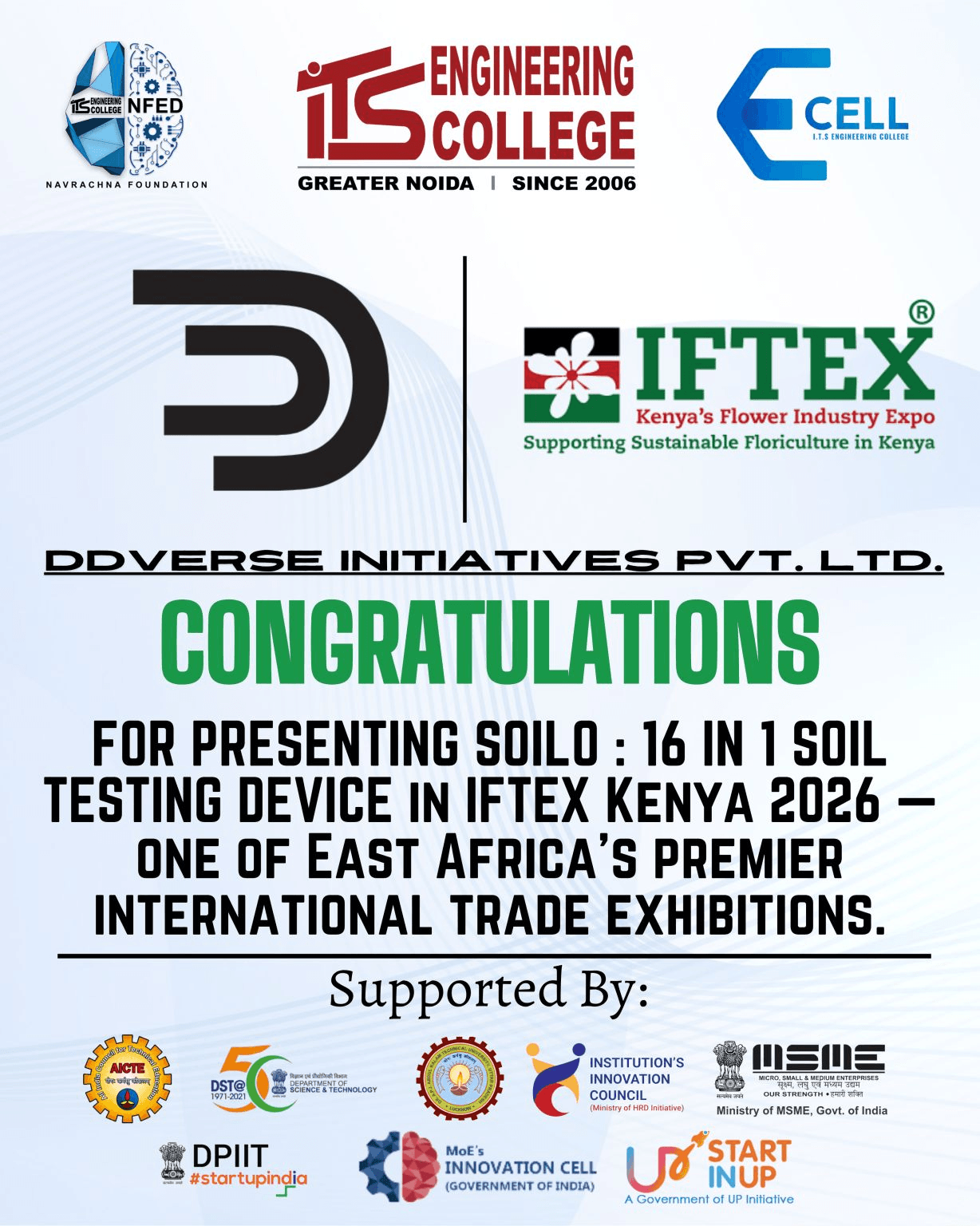
Our participation was acknowledged in a congratulatory update from I.T.S Engineering College, Greater Noida, and its entrepreneurship community, including the Navrachna Foundation. The institutional poster described Soilo as a sixteen-in-one soil-testing device. We appreciated the recognition and the opportunity to bring attention to a product developed through sustained work across hardware, software, manufacturing and customer support.
Why floriculture is an important conversation for agritech
Flower production is a demanding agricultural activity. Growers are concerned with crop quality, consistency, timing and efficient management of inputs. The precise needs differ between farms and growing systems, but information about soil conditions can help inform management discussions. A field tool intended for agricultural users must therefore be assessed in relation to the grower's actual crop, substrate, irrigation practice and operating environment.
We are interested in these conversations because they expose the limits of one-size-fits-all thinking. A device that provides useful information in one setting may require additional evaluation in another. Conditions affecting measurements can differ, and the relevance of a parameter depends on the management question being asked. International exhibitions offer a chance to understand these differences before treating an application as established.
Soilo's approach is to combine portable field-oriented sensing with a digital reporting workflow. We want operators to be able to collect observations, organise them and communicate the results more easily. This can create a useful starting point for discussions, particularly when records are compared over time. It does not replace agronomic judgement, appropriate sampling or laboratory testing where the intended application calls for a reference method.
Taking Indian technology into an international industry
Kenya is an important location for conversations about commercial horticulture and floriculture. For a young technology company from India, an event such as IFTEX creates an opportunity to learn how international growers and agricultural businesses frame their requirements. Some may be interested in field convenience. Others may focus on repeatable procedures, reporting, cost of operation or service arrangements. Each question helps clarify whether a product meets a practical need.
The international context also brings new responsibilities. Documentation must be understandable to users who are unfamiliar with the development team. Training needs to address the conditions in which the device will actually be handled. Any parameter presented by the product should be explained according to its method. Direct measurements, estimates and derived outputs need to be distinguished rather than grouped under a single unqualified accuracy claim.
We believe that clarity is particularly important for professional agricultural users. A grower or consultant may compare information from different sources and will reasonably want to understand why results differ. Our role is to provide a transparent product experience, identify the intended use and explain when an independent reference test or additional sampling is appropriate.
The engineering behind a field device
International exhibitions allow people to see the finished device, but the engineering work continues far beyond the demonstration. Portable sensing technology depends on choices involving electrodes, optical components, electronics, power management, firmware and mechanical design. Those systems must be integrated with an application capable of handling records in a clear, consistent way.
Manufacturing introduces another layer of work. A product needs repeatable assembly procedures, defined testing steps and documentation that can be used by more than one technician. Components need to be sourced and checked. Firmware versions need to be managed. A customer-support team needs enough technical information to investigate problems without relying on the person who originally designed the product.
These requirements are not always visible in a short exhibition conversation. They are, however, what determine whether a customer can continue using the technology after the event. As Soilo grows, we want our processes to become more dependable along with the products themselves.
What industry conversations can teach us
A demonstration is especially useful when visitors are willing to explain their existing workflow. How is soil or growing media currently tested? How often are samples taken? Who records the information? Does the decision require immediate field guidance or formal laboratory evidence? What would make a new tool worth integrating into an established routine?
These questions are important because the right use case cannot be inferred from the product's specification sheet alone. A field observation tool may be most helpful as a screening or recordkeeping aid. Another customer may need a more formal analytical method. We would rather identify that distinction early than promise an application that has not been properly validated.
For our software team, conversations about international use also inform how information should be displayed and retained. A well-structured report should make it clear when and where an observation was recorded, what the values mean and how the data might be compared or shared. When outputs include model-supported estimates, presentation should help the user understand those limitations. Good reporting is a part of technical quality, not merely a visual feature.
Recognition from our startup ecosystem
We are grateful to I.T.S Engineering College, the Navrachna Foundation and the wider entrepreneurship community for acknowledging Soilo's participation at IFTEX. Their support reflects the importance of institutions that encourage young businesses to move beyond prototypes and engage with real markets. International exposure can help a team better understand product requirements and build the confidence to address complex technical questions.
We see such recognition as encouragement, not as a substitute for independent evidence about a device's performance. The most meaningful long-term measure of progress will remain the experience of customers who use the technology repeatedly, receive appropriate support and can interpret its outputs responsibly. Recognition gives visibility to the work; the quality of the work must sustain it.
Building relationships through useful information
Soilo's larger ambition is to make ground and environmental intelligence more accessible across different applications. Agriculture remains a central part of that work because soil information is directly relevant to the people managing land and crops. As we explore additional environmental products and enterprise workflows, we intend to apply the same discipline to measurement methods, data records and claims.
IFTEX Kenya 2026 was a valuable opportunity to present our work within the context of a specialised agricultural industry. It encouraged us to consider the questions that growers and agricultural professionals are likely to ask before using a new technology. Those questions are not obstacles to innovation. They are the way a product becomes better suited to its purpose.
We thank the people and institutions who helped make the participation possible, and everyone who engaged with Soilo's technology. Our team will continue learning from international agricultural communities, improving the tools we build and keeping our focus on a practical outcome: environmental information that is easier to obtain, clearer to understand and more useful in real field decisions.